
This work was done for a Macquarie University Art Gallery exhibition, The Immersive Power of Light,
in August-September 2024. Curated by Rhonda Davis, Leonard Janiszewski and Andrew Simpson, the exhibition featured 40 works by
18 artists, all exploring the multifaceted nature of light through different artistic mediums.
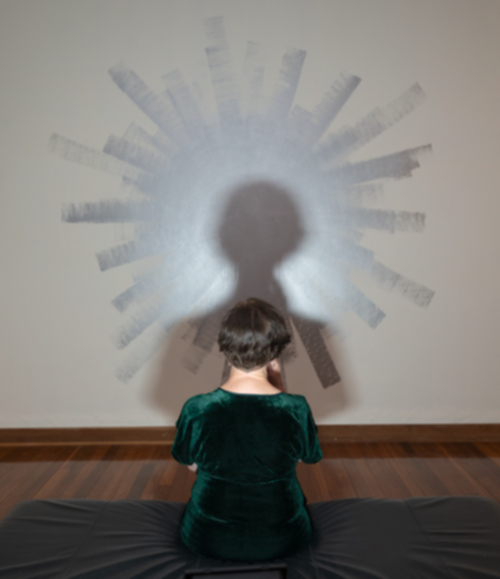
Originally we discussed a remake of one of my light based installations but in the end I decided to make a new work in the spirit of those early works. I used the non-art materials I commonly used at that time, meaning everyday items you can use or buy at a regular hardware store. I bought a work lamp on a stand from Bunnings, used one of the gallery benches, and created a sort of mural on the gallery wall with reflective aluminum paint. The lamp stood behind anyone sitting on the bench, casting their silhouette on the reflective wall.
Earlier light works were always untitled. Even though they often used the viewer’s shadow as an element of the work, after all these decades I wanted to make the symbolic element very clear, that we all essentially live in Plato’s Cave, misreading shadows as reality when in fact the shadows are just ourselves.
But rather than talk about it any more I’ll reprint the catalogue essay Lizzy Marshall has written about it.
Entering into Plato’s Cave
lan Milliss is a difficult artist to pin down through his practice alone. Like so many artists of the 20th century, he works in a post-disciplinary, post-medium and largely a post-material way. His practice also defies characterisation as purely conceptual. However, it is not surprising that as an artist who began as a painter exhibiting through Central Street Gallery in the 1960s, that light was always going to be a prescient medium and influence. Plato’s Cave (2024) moves beyond an exploration of the philosopher’s allegory of those with knowledge should lead those without. It draws upon recurring themes within the artist’s 60-year career.
This new installation is a confluence of Milliss’ conceptual and political concerns of what art, material and the participant means. In its simplest agenda it draws on his early participatory performative works, and yet here it is for an exhibition on artists’ explorations of light. Yet what Milliss is highlighting within Plato’s Cave is our relationship to light. Metaphors for knowledge aside, congruent within the work is Milliss’ persistent concerns of everyday activities as cultural practice.
While Milliss may be recalled as painter, alongside his studio practice he also has a strong social practice. This articulated itself through activism, which cemented his commitment to labour as a creative action and cultural work, regardless of who performed it. This early turn in his practice de-centres the artist as the sole arbiter of art making and engages the everyday actions of people as the creators. His conceptual works have extended even further over the years to engage the everyday through an examination of our living spaces and social infrastructure. More recently, his work looks for structural remodelling to address the urgencies of the everyday, and how this can be a creative action to bring about change through cultural collectivism, as per his activities in the Kandos School of Cultural Adaptation.
Themes of the performative, action-based and ordinary interactions of the everyday are seen through the artist’s seminal Walk Along This Line (1970) and Circular Tug of War (1971). Both early works were provocations of the impossible and invitations to participate in the arbitrary. Where Plato’s Cave departs is from Milliss previously positioning us in the impossible, to now quietly sitting within where we can be possible.
The installation is created as a performance-enacted work; that is, the audience by engaging with the direction of the light animates the material of the work through immaterial action. In this way, we know that we are object, action and shadow. Easy assumptions have us attuned with Platonian theory of being complicit to our own ignorance. Yet, Milliss provides us with a more positive framework, since the artwork is only completed by our participation. And though this work is created within the confines of a contrived light in a prescribed space for audiences to engage with it, through Plato’s Cave we fulfill the artist’s belief that everyone is an artist.